Automated Ventilation System Working Flow
| Stage | Process | Technology Used | Result |
|---|---|---|---|
| Detection | Sensors monitor air quality, humidity, occupancy | IoT environmental sensors | Real-time environmental awareness |
| Analysis | System evaluates airflow demand | Control algorithms / BMS | Identifies ventilation needs |
| Adjustment | Airflow is increased or reduced automatically | Variable speed fans, dampers | Balanced ventilation response |
| Optimization | System fine-tunes airflow continuously | Feedback loops | Stable comfort conditions |
| Maintenance Alerts | System notifies filter or fault issues | Predictive diagnostics | Reduced downtime and failures |
Ventilation decisions often feel simple until a building starts behaving differently than expected. The air feels stale. Comfort varies from room to room. Energy use climbs without a clear reason. We usually trace these issues back to one choice made early. The ventilation system. Traditional approaches still work in many places, yet automated systems have changed expectations. Choosing between them depends less on trends and more on how a building actually lives and breathes.
What Are Traditional Ventilation Systems?
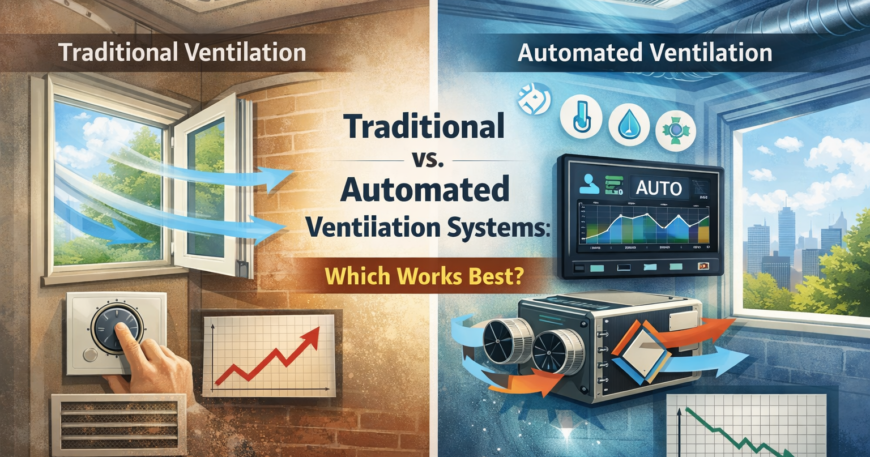
Traditional ventilation relies on straightforward mechanics. Fans move air. Windows provide natural airflow. Controls remain manual. These systems feel familiar because they are predictable. We adjust settings when discomfort appears. The challenge emerges over time. Airflow stays constant even when conditions change. Stale air lingers in corners. Energy use remains fixed regardless of occupancy. Traditional methods work best when buildings behave consistently, which rarely happens in practice.
How Automated Ventilation Systems Work
Automated systems observe before they react. Sensors monitor temperature, humidity, and air quality. Controllers adjust airflow automatically. Fresh air enters when needed. Exhaust responds to real conditions. We often notice spaces feel calmer with automation in place. Air changes gradually rather than abruptly. Automated ventilation works quietly in the background, responding to behaviour instead of forcing fixed schedules on dynamic spaces.
Benefits of Automated Ventilation Over Traditional Methods
Automation changes daily operations more than people expect. Systems no longer rely on memory or manual adjustment. They respond continuously. This shift improves comfort and consistency. Health benefits follow when fresh air remains steady. Energy efficiency improves because systems stop working unnecessarily. Automated approaches suit buildings where usage changes throughout the day, which describes most modern environments.
Energy Savings with Heat and Chill Recovery
Heat and chill recovery systems reuse energy that would otherwise escape. Warm exhaust air preconditions incoming fresh air. Cooling works the same way. We see energy savings build slowly but consistently. Recovery does not feel dramatic. It simply reduces waste over time.
Improved Airflow and Indoor Air Quality
Automation supports proper ventilation without constant oversight. Fresh air remains consistent. Pollutants dilute gradually. Sensors adjust airflow before discomfort becomes noticeable. Indoor air quality improves because systems respond early rather than late.
Reduced Noise Levels
Automated systems often operate at lower speeds. Fans run only when needed. Noise reduces naturally. We notice quieter environments, especially during off-peak hours. Comfort improves without conscious effort.
Maintenance and Longevity
Automation reduces unnecessary strain. Systems avoid continuous operation. Filters receive alerts when attention is needed. Maintenance becomes predictable. Longevity improves because components work within intended ranges rather than extremes.
Installation and Expert Services
Even the smartest system depends on correct installation. Sensors require proper placement. Controls need calibration. Poor setup limits potential benefits. We have seen automated systems underperform due to rushed installation. Expert planning ensures systems respond accurately to real conditions. Good installation protects both comfort and long-term reliability.
Cost-Effectiveness of a Modern Ventilation System
Costs rarely tell the full story at installation. Traditional systems appear simpler upfront. Automated solutions recover value over time. Energy savings accumulate quietly. Maintenance becomes easier to plan. The ventilation system pays back through stability rather than speed. ROI improves when systems match real usage patterns instead of running continuously without purpose.
Choosing the Right System for Your Building
No single solution fits every building. Some spaces benefit from simplicity. Others demand responsiveness. At Bilal Switchgear Engineering, we help clients choose systems based on behaviour, not labels. Our ventilation system solutions focus on comfort, efficiency, and long-term performance.
FAQs
Is automated ventilation always better than traditional systems?
Not always. Automated systems suit variable usage. Traditional systems work well in stable environments with predictable occupancy.
Does automation increase system complexity?
It adds intelligence, not confusion. Clear design keeps systems understandable for operators and maintenance teams.
Can automated ventilation reduce energy bills?
Yes. Systems respond to demand, reducing unnecessary operation and lowering long-term energy consumption.
Are traditional ventilation systems outdated?
No. They remain effective in simple layouts. Their limitations appear when conditions change frequently.
How important is installation quality for automated systems?
Very important. Sensors and controls require accurate placement and calibration to function correctly.
Can ventilation upgrades improve indoor comfort quickly?
Yes. Improved airflow consistency often delivers noticeable comfort improvements soon after commissioning.