
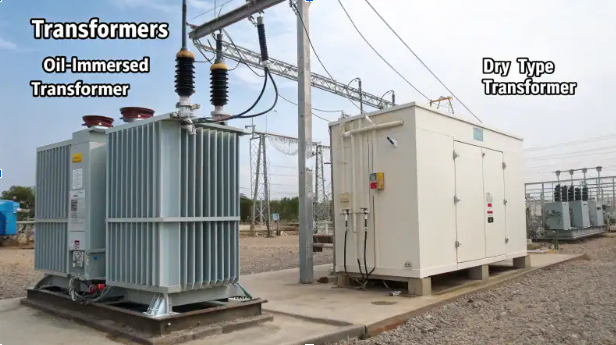
With advancements in industry, the electrical infrastructure and demand are becoming safer with each passing day. They are becoming more efficient and environmentally friendly. The traditional and old oil-filled transformers have served the power distribution system for decades. Many organizations are shifting towards dry type transformers due to safety concerns. As such, transformers are low-maintenance and sustainable for modern industrial and commercial environments.
In today’s world, dry type transformers play a significant role in industrial power management, electrical infrastructure development, and modern power distribution. The increase in growth adaptation also reflects a broader industrial trend towards more efficient and sustainable electrical solutions.
What are Dry Type Transformers?
A dry type of transformer is an electrical transformer that uses air and solid insulation material instead of liquid insulating oil to cool and insulate its windings. Compared with traditional oil-filled transformers, dry units do not use flammable liquids. It makes them safer for indoor insulation and more environmentally sensitive.
Modern dry type transformers use vacuum-impregnated (VPI) insulation or cast-resin technology. Such insulation systems provide excellent electrical performance while protecting the transformer windings from moisture, dust, wind, and rain. As they eliminate the need for insulating oil, dry type transformers offer significant advantages in safety, maintenance, and installation flexibility. This helps them become attractive for facilities where fire protection and environmental compliance are main concerns.
How Dry Type Transformers Work
The working principle of the dry type transformers is very similar to that of any power transformer. Electrical energy is transferred between the primary and secondary windings via electromagnetic induction. This helps to allow the voltage level to be increased or reduced, depending on the system requirements.
The main difference is in the cooling and the insulation methods. Instead of relying on transformer oil for cooling, dry type transformers use air circulation and advanced insulating materials to manage temperatures. The main and basic operation process for the dry type transformers includes the following features:
- Electrical power enters the primary windings
- A magnetic field is generated within the transformer core
- The magnetic field induces a voltage in the secondary winding
- Output voltage is delivered to connected loads
- The heat generated during the operation is dissipated through the air-cooling systems
The advanced design eliminates many environmental and safety concerns associated with oil-filled transformers.
Comparison Between Dry Type Transformers and Oil-Filled Transformers
The most commonly asked question, mainly by engineers and facility managers, is whether dry type transformers or oil-filled transformers are better. As both technologies perform the same fundamental functions, their design, infrastructure maintenance requirements, and operational characteristics are entirely different.
Here is a comparison of features between the dry type transformer and the oil-filled transformer:
| Features | Dry Type Transformer | Oil-Filled Transformer |
| Cooling Method | Air cooling | Oil cooling |
| Fire Risk | Very Low | Higher |
| Environmental Impact | Environmentally friendly | Oil leakage risk |
| Indoor Installation | Ideal | Additional safety measures required |
| Maintenance Requirement | Low | Moderate to high |
| Moisture Resistance | excellent (Cast Resin) | Good |
| Operating Safety | High | Moderate |
| Installation Flexibility | High | Moderate |
Key Benefits of Dry Type Transformers
The growing popularity of the dry type transformers has many significant operational and financial advantages.
- Enhanced Safety: As one of the essential advantages of dry-type transformers, it has improved safety. As such, transformers have no inflammable insulating oil, so the risk of fire and explosion is significantly higher. This makes them suitable for hospitals, data centers, commercial buildings, educational institutions, underground facilities, and high-occupancy structures. The improved fire safety helps the organizations meet the modern building and safety requirements.
- Lower Maintenance Requirements: The oil-filled transformers require periodic oil testing, filtration, replacement, and leak monitoring. Dry type transformers eliminate these maintenance tasks. The benefits include the reduction in maintenance costs, less downtime, simplified inspections, and improvement in reliability. The facility managers also translate them into the life cycle operating cost.
- Environmentally Friendly Operations: Environmental sustainability is becoming increasingly important in many industries and commercial projects. The dry type transformers eliminate the oil leakage risks, reduce environmental contamination, support the green building initiative, and improve workspace safety.
- Improved Indoor Installation Capability: The dry type transformer does not need the oil containment systems, as they are often installed closer to the electrical loads. This helps them in space saving, reduction in cable lengths, simplified infrastructure planning, and improved flexibility. The indoor installation capability also remains one of the best advantages.
Why Industries are Replacing Oil-Filled Transformers
The shift of the old traditional oil-filled transformers towards the dry type transformer solutions is widely used by changing the operational requirements and evolving the safety standards. Environmental considerations are also influencing the purchasing decisions. The leakage of transformer oil can also contaminate the soil and groundwater and help to create environmental risks and potential regulatory concerns. Sustainability also becomes a large focus for industrial operations, and many organizations are also investing in much cleaner and more environmentally friendly technologies.
The digital transformation is another driving factor. In today’s world, the industries are adopting smart monitoring systems, predictive maintenance technologies, and automated asset management solutions. So their modern transformer designs help to integrate more easily with intelligent monitoring systems and help the organization to improve the visibility and reduce the likelihood of unexpected failures.
Here are some key factors why industries are making the change:
| Key Factors | Why Industries Are Making Change |
| Fire Safety | Reduces the risks associated with the flammable insulating oil |
| Lower Maintenance | Minimizes the oil testing, leak inspections, and maintenance requirements |
| Environmental Protection | Eliminates the concerns related to the oil leakage and contamination |
| Space Efficiency | Supports the compact installation and the flexible infrastructure designs |
| Improved Monitoring | Easier integration with the smart monitoring and predictive maintenance systems |
| Regulatory Compliance | Helps meet evolving safety and environmental standards |
| Operational Reliability | Supports stable and efficient long-term performance |
The oil-transformers continue to play an integral part in many applications, and the industries are also moving towards the alternative that offers enhanced safety, lower maintenance, and improved environmental performance. The facilities continue to modernize; the transition towards the smarter and more sustainable transformation technologies is expected to be accelerated.
Application of Dry Type Transformer
There are various types of applications of dry type transformers used across a wide range of industries and applications.
- Commercial Buildings: In many shopping malls, office towers, hotels, and commercial complexes, the dry type transformers are widely used because of their safety advantages and indoor installation sustainability.
- Manufacturing Facilities: In many industrial plants, the system relies on the transformers to support the machinery, automation systems, motor control centers, and power distribution networks. The dry type transformers provide reliable power while minimizing the maintenance requirements.
- Hospitals and Healthcare Facilities: The healthcare environment requires extremely reliable infrastructure. The dry type transformers support the medical equipment, emergency power systems, critical care facilities, and diagnostic equipment. The low fire risk is valuable in the healthcare setting.
- Data Centers: The data centers depend on continuous power availability. The dry type transformers help to protect the servers, network equipment, and storage systems. mission-critical infrastructure. This reliability supports uninterrupted operations.
- Renewable Energy Projects: The solar and renewable energy facilities increasingly utilize the dry type transformers because of their environmental and operational advantages.
Conclusion
The dry type transformers are becoming a popular choice because they offer a safer, cleaner, and more efficient alternative to traditional oil-filled transformers. With the lower maintenance requirement, it reduces the fire risk and is environmentally friendly. They are well-suited for modern industrial, commercial, and infrastructure applications.
The businesses continue to upgrade the electrical systems; the dry type transformers provide reliable power distribution while helping to reduce the operating costs and improve safety. The versatility and long service life with modern power networks make them a smart investment for organizations looking for future-ready electrical solutions.
FAQs
What is a dry type transformer?
The dry type transformer is a transformer that uses air and solid insulation materials instead of insulating oil for cooling and insulation.
Why are dry type transformers safer than oil-filled transformers?
The dry type transformer does not contain flammable oil, which significantly reduces the fire and environmental risks.
Where are dry type transformers commonly used?
The dry type transformers are used in commercial buildings, hospitals, manufacturing facilities, data centers, renewable energy projects, and industrial power systems.
Do dry type transformers require less maintenance?
Yes, they eliminate the need for oiling, testing, filtration and leak management, resulting in lower maintenance requirements.
Are dry type transformers replacing oil-filled transformers?
In many indoor and commercial applications, dry type transformers are increasingly replacing the oil-filled system due to their safety, environmental, and maintenance advantages.