
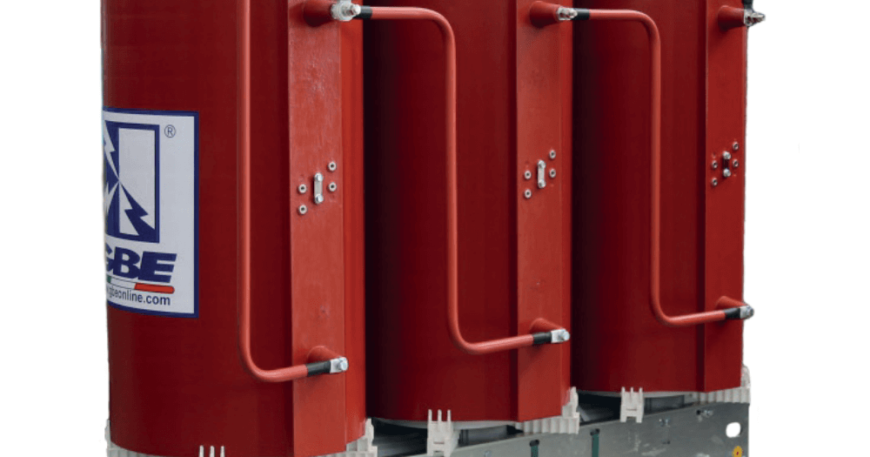
Pakistan’s rapid expansion of high-rise commercial buildings, data centres, hospitals, pharmaceutical facilities, and urban infrastructure is creating a growing demand for transformer technology that conventional oil-filled units cannot safely deliver. An oil-filled transformer installed in the basement of a ten-storey commercial building, inside a hospital ward block, or adjacent to a pharmaceutical clean room represents an unacceptable fire and contamination risk that building owners, insurers, and regulatory authorities are increasingly unwilling to accept.
Dry type transformers eliminate these risks by using solid or air insulation instead of transformer oil. They can be installed indoors, in occupied buildings, in fire-sensitive environments, and in locations where oil leakage would be catastrophic. This guide explains how dry type transformers work, the difference between cast resin and vacuum pressure impregnated designs, which applications require each type, how to read the key specifications, and why the choice of transformer supplier in Pakistan matters for long-term reliability and after-sales support.
Bilal Switchgear Engineering is the sole authorised distributor of GBE dry type transformers from Italy for Pakistan and Afghanistan. GBE transformers are available up to 30 MVA and 52 kV, type-tested by CESI (Italy) to the latest IEC standards, and compliant with the EU Eco-design Directive for guaranteed reduced losses. This article is written by our engineering team to help electrical consultants and procurement professionals make informed transformer specification decisions.
What Makes a Transformer Dry Type?
All transformers perform the same basic function: transferring electrical power between two circuits at different voltages through electromagnetic induction in a laminated steel core wound with copper or aluminium conductors. The fundamental difference between oil-filled and dry type transformers is the insulation and cooling medium used around the windings.
In an oil-filled transformer, the core and windings are immersed in mineral transformer oil, which provides both electrical insulation between windings and cooling by convection through the oil and external radiators. Oil-filled transformers are highly efficient and cost-effective for outdoor and substation installations. However, the oil represents a fire risk, a potential environmental contamination hazard, and a maintenance requirement for oil sampling and replacement over the transformer’s service life.
In a dry type transformer, the windings are insulated using either cast resin or vacuum pressure impregnated varnish, and cooled by natural or forced air circulation. There is no oil to leak, ignite, or contaminate. The governing standard for dry type transformers is IEC 60076-11, which defines the performance, testing, and marking requirements for dry type power transformers.
Cast Resin vs Vacuum Pressure Impregnated: Understanding the Difference
The two main manufacturing technologies for dry type transformers serve overlapping but distinct application ranges. Selecting the correct technology for a specific project in Pakistan requires understanding what each offers and where each has limitations.
Cast Resin Transformers (CRT)
In a cast resin transformer, the high-voltage and low-voltage windings are completely encapsulated in epoxy resin cast under vacuum. The resin forms a rigid, self-extinguishing insulation body around each winding coil. Cast resin transformers carry Class F insulation rating (maximum winding temperature 155 degrees Celsius) and are classified E2 for environmental severity, C2 for climatic conditions, and F1 for fire behaviour under IEC 60076-11.
The fully encapsulated winding construction provides outstanding resistance to moisture, dust, chemicals, and vermin — all significant environmental challenges in Pakistan’s industrial and commercial building environments. Cast resin transformers can be stored in humid conditions without degradation, installed near chemical processes, and operated continuously in coastal environments with salt-laden air without the accelerated insulation degradation that affects oil-filled units in the same conditions.
- Maximum winding temperature class: F (155°C)
- Environmental classification: E2 (severe — condensing humidity, chemical atmosphere)
- Climatic classification: C2 (outdoor storage capable)
- Fire behaviour classification: F1 (self-extinguishing, no burning droplets)
- Partial discharge level: below 10 pC (GBE guarantee below 5 pC on request)
- Typical rating range: 50 kVA to 30 MVA, up to 52 kV primary voltage
Vacuum Pressure Impregnated Transformers (VPI)
In a vacuum pressure impregnated transformer, the windings are wound with Nomex paper or polyester film insulation and then impregnated under vacuum with a solvent-free varnish that penetrates all voids and bonds the insulation into a consolidated structure. VPI transformers carry Class H insulation rating (maximum winding temperature 180 degrees Celsius), which gives them a higher thermal operating margin than cast resin units at equivalent ratings.
VPI construction is well suited to applications with variable loads and frequent switching cycles, where the higher thermal class provides greater protection against hot-spot temperatures during load transients. VPI transformers are also generally more economical than cast resin units at equivalent ratings, making them the preferred specification for applications that do not require the E2/C2 environmental robustness of cast resin.
- Maximum winding temperature class: H (180°C)
- Environmental classification: E1 (standard indoor — moderate humidity, no condensation)
- Climatic classification: C1 (conditioned indoor environment)
- Insulation material: Nomex paper or polyester film with varnish impregnation
- Typical rating range: 50 kVA to 5 MVA for most Pakistani VPI suppliers
Key selection rule: Specify cast resin where the transformer will be installed in humid, dusty, coastal, or chemically aggressive environments — or where fire risk minimisation is a design requirement. Specify VPI where the installation environment is clean and climate-controlled and where the higher thermal class and lower cost of VPI provides a better value proposition. When in doubt for Pakistani industrial and commercial applications, cast resin is the more conservative and appropriate choice.
Why Pakistan’s Market is Shifting Towards Dry Type Transformers
Five converging factors are driving growth in dry type transformer specification across Pakistan’s commercial, industrial, and infrastructure sectors.
Indoor Installation Requirements
Pakistan’s high-rise commercial construction boom in Lahore, Karachi, and Islamabad is placing transformer installations inside occupied buildings where oil-filled units would create unacceptable fire risks. The PKLI (Pakistan Kidney and Liver Institute), Centaurus Mall, and similar landmark facilities require transformers installed within the building envelope where dry type is the only technically acceptable solution.
Fire Safety Regulations
Increasingly, building codes and insurance requirements for commercial and industrial buildings in Pakistan’s major cities are specifying fire-resistant transformer technology for indoor electrical rooms. Dry type cast resin transformers with F1 fire behaviour classification satisfy these requirements. Oil-filled transformers do not, regardless of whether fire suppression systems are provided in the transformer room.
Environmental and Contamination Sensitivity
Pakistan’s pharmaceutical, food processing, and healthcare sectors cannot risk transformer oil contamination of production environments. A transformer oil leak in a pharmaceutical facility triggers a regulatory investigation and potential product recall. Dry type transformers eliminate this risk entirely. For hospital power systems serving critical care areas, the combination of no fire risk and no contamination risk makes dry type the only appropriate specification.
Data Centre Power Infrastructure
Pakistan’s growing data centre sector requires high-reliability, low-maintenance power infrastructure at current density levels that make oil-filled transformers impractical in server room environments. Dry type transformers deliver the required ratings in compact, indoor-rated packages with service lives exceeding 25 years under normal data centre operating conditions.
Eco-Design and Energy Efficiency Requirements
International project lenders and multinational corporate clients operating in Pakistan are increasingly requiring transformer efficiency compliance with the EU Eco-design Directive (EU 2019/1783), which mandates reduced no-load and load losses for distribution transformers. GBE Italy transformers distributed by Bilal Switchgear Engineering are Eco-design compliant with guaranteed zero-tolerance lower losses — a specification that most locally manufactured transformers in Pakistan cannot meet.
GBE Italy Dry Type Transformers: Technical Specifications
GBE S.r.l. is an Italian manufacturer of dry type power transformers with an established global installation base. Bilal Switchgear Engineering holds sole authorised distributor status for GBE transformers in Pakistan and Afghanistan. The GBE range offers capabilities that exceed those of other dry type transformer suppliers currently active in Pakistan.
Rating Range
GBE transformers are available from 50 kVA up to 30 MVA. This upper limit of 30 MVA significantly exceeds the 5 MVA maximum offered by Pakistan’s other dry type transformer suppliers, making GBE the only dry type option available in Pakistan for large industrial and grid-connected applications that previously required oil-filled units.
Primary Voltage Range
GBE transformers are available for primary voltages up to 52 kV. This covers the full range of Pakistani distribution voltages including 11 kV, 33 kV, and 132 kV, allowing dry type specification for primary receiving substations in addition to standard secondary distribution applications.
Winding Material
Both copper and aluminium winding options are available across the GBE range. Copper windings provide lower resistance, smaller physical dimensions, and longer service life under cyclic loading conditions. Aluminium windings provide cost savings where installation space is not constrained and operating conditions are stable.
Type Testing
GBE transformers are type-tested by CESI (Centro Elettrotecnico Sperimentale Italiano), one of Europe’s most respected independent electrical test laboratories. CESI type test reports are accepted by NTDC, major Pakistani DISCOs, and international project lenders as evidence of IEC 60076-11 compliance. Test reports are provided as standard with all GBE transformer deliveries.
Eco-Design Compliance and Loss Guarantee
GBE transformers comply with the EU Eco-design Directive (EU 2019/1783) for reduced losses and carry a guaranteed zero-tolerance lower losses certification. This means the transformer’s actual no-load and load losses are guaranteed not to exceed the values declared on the nameplate, verified by CESI testing. For clients calculating lifetime energy cost of ownership, this guarantee eliminates the uncertainty that affects transformers without formal loss compliance certification.
K-Factor Rating: Why Harmonic Loads Need Specially Rated Transformers
One of the most frequently overlooked dry type transformer specifications in Pakistan is the K-factor rating, which determines how well a transformer handles non-sinusoidal (harmonic-rich) load currents.
Conventional transformers are designed for sinusoidal current at 50 Hz. Modern industrial and commercial loads including variable speed drives, UPS systems, data centre server power supplies, LED lighting drivers, and rectifier-based process equipment draw non-sinusoidal currents that contain harmonic components at multiples of the fundamental frequency. These harmonic currents cause additional eddy current losses in the transformer core and windings, creating localised hot spots that can significantly reduce transformer service life if the unit is not rated for the harmonic content of its load.
K-factor is a measure of the harmonic content of the load current and its effect on transformer heating. A standard transformer has a K-factor rating of K1. For data centre and UPS applications with predominantly switch-mode power supplies, K13 or K20 ratings are typically specified. For variable speed drive applications in industrial facilities, K4 or K7 ratings are common.
Specification note: When specifying a dry type transformer for a facility in Pakistan where variable speed drives, UPS systems, or data centre equipment represents a significant proportion of the load, always specify the required K-factor rating based on a harmonic load analysis. A standard K1-rated transformer installed on a high-harmonic load will run hotter than its thermal class permits, reducing its service life from 25 years to as few as 10 years in severe cases.
Dry Type Transformer Applications in Pakistan: Sector Guide
Hospitals and Healthcare
Hospitals including Indus Hospital Lahore require dry type transformers for indoor electrical rooms serving critical care, operating theatres, and diagnostic imaging departments. The F1 fire classification, E2 environmental rating, and zero contamination risk of cast resin transformers make them the standard specification for healthcare facilities. GBE transformers supplied by Bilal Switchgear Engineering have been installed in healthcare infrastructure projects delivered by our MEP Division.
High-Rise Commercial Buildings
Basement and mid-floor electrical rooms in high-rise office towers, residential buildings, and mixed-use developments in Lahore, Karachi, and Islamabad require indoor-rated transformer technology. Cast resin transformers in IP23 or IP54 enclosures satisfy building fire regulations and insurance requirements that oil-filled transformers cannot meet.
Pharmaceutical and Food Processing
GMP-compliant pharmaceutical manufacturing facilities and food processing plants in Pakistan specify dry type transformers for all indoor electrical rooms to eliminate the contamination risk of transformer oil in proximity to production areas. The E2 environmental classification provides additional protection against the humidity and cleaning chemicals encountered in these facility types.
Data Centres and Telecommunications
Pakistan’s data centre sector, growing rapidly in response to digital economy expansion, requires high-reliability transformer installations within air-conditioned building environments. K-factor rated cast resin transformers with appropriate harmonic compensation provide the load capability and efficiency that Tier III and Tier IV data centre specifications demand.
Renewable Energy and Grid Infrastructure
Solar and wind energy installations in Pakistan increasingly specify dry type step-up transformers where the installation location makes oil-filled units environmentally risky or impractical. GBE’s availability up to 30 MVA and 52 kV makes them one of the very few dry type options in Pakistan capable of meeting the rating requirements of utility-scale renewable energy and grid connection applications. Our Power Division supplies GBE transformers with complete integration into ABB switchgear installations.
Specifying a Dry Type Transformer for Your Project in Pakistan
Dry type transformers are no longer a specialist product for unusual applications. They are the technically correct and commercially competitive choice for any indoor transformer installation in Pakistan where fire safety, environmental robustness, contamination sensitivity, or maintenance minimisation are genuine design requirements. The choice between cast resin and VPI depends on the specific installation environment. The choice of supplier determines the quality of the equipment, the depth of type test documentation, and the reliability of after-sales support over the transformer’s 25-plus year service life.
Bilal Switchgear Engineering supplies GBE Italy dry type transformers as sole authorised distributor for Pakistan and Afghanistan. GBE transformers are available up to 30 MVA and 52 kV, type-tested by CESI to IEC 60076-11, Eco-design compliant with guaranteed lower losses, and supported by our engineering team for specification consultation, project supply, and installation through our MEP Division.
Contact our engineering team in Lahore to discuss your transformer project requirements, request type test documentation, or obtain a formal quotation for GBE dry type transformers.
Frequently Asked Questions
What is the difference between a dry type transformer and an oil-filled transformer?
An oil-filled transformer uses mineral transformer oil as both insulation and cooling medium. The oil provides excellent thermal performance and allows efficient cooling through external radiators. However, oil creates fire risk, environmental contamination hazard, and requires regular maintenance. A dry type transformer uses solid resin or impregnated varnish insulation and air cooling. There is no oil to leak, ignite, or contaminate. Dry type transformers are installed indoors in occupied buildings, healthcare facilities, and environmentally sensitive locations where oil-filled transformers are unsafe or prohibited.
What ratings are available for GBE dry type transformers in Pakistan?
Through Bilal Switchgear Engineering’s sole distributorship, GBE dry type transformers are available from 50 kVA up to 30 MVA and for primary voltages up to 52 kV. Both cast resin and vacuum pressure impregnated types are available, with copper or aluminium windings. Standard ratings from 100 kVA to 2500 kVA at 11 kV primary voltage are typically available on short lead times. Larger ratings and special configurations are manufactured to order with standard European production lead times.
Are dry type transformers more expensive than oil-filled transformers in Pakistan?
Dry type transformers typically carry a higher initial purchase price than comparable oil-filled units, generally 20 to 40 percent higher depending on rating and specification. However, the total cost of ownership over the transformer’s service life frequently favours dry type for indoor applications when civil works, fire suppression systems, oil containment bunding, periodic oil testing, and oil change costs are included in the comparison. For high-rise building installations where the alternative is an outdoor oil-filled transformer requiring expensive cable runs to serve upper floors, indoor dry type at each building level is often the more economical overall solution.
Does a dry type transformer require special maintenance in Pakistan’s climate?
Cast resin dry type transformers require very little routine maintenance compared to oil-filled units. The primary maintenance tasks are periodic cleaning of the ventilation grilles and winding surfaces to remove accumulated dust (important in Pakistan’s dusty industrial environments), annual thermographic inspection under load to identify any hotspots at connection points, and inspection of cooling fan operation for forced-cooled units. There are no oil samples to take, no moisture assessments to conduct, and no oil changes required. The reduced maintenance burden is a significant operational advantage for facilities where maintenance resource is limited.
Can a dry type transformer be installed outdoors in Pakistan?
Standard dry type transformers are rated for indoor installation. Outdoor installation requires an appropriate weather-protective enclosure with minimum IP23 protection for light rain exposure or IP54 for exposed locations. GBE offers transformer packages with outdoor enclosures rated to IP54 for installations where the transformer cannot be located within a building. For fully exposed outdoor installations subject to Pakistan’s monsoon rainfall and direct solar heating, an oil-filled transformer in a conventional outdoor substation is generally more economical than an outdoor-enclosed dry type unit at ratings above 1 MVA.
