
Pakistan’s industrial sector operates in some of the most thermally challenging conditions in Asia. Summer temperatures in Punjab and Sindh regularly exceed 45 degrees Celsius outdoors. Inside a textile mill, cement plant, steel fabrication workshop, or warehouse with metal roofing, the working temperature can reach 55 degrees or higher without adequate ventilation. At these temperatures, worker productivity falls sharply, heat-related illness becomes a serious risk, and equipment operating outside its thermal design limits begins to fail prematurely.
Properly designed industrial ventilation systems do three things simultaneously: they remove heat generated by processes, equipment, and solar gain; they supply fresh air to maintain acceptable oxygen and carbon dioxide levels for workers; and they dilute or extract airborne contaminants including dust, fumes, and chemical vapors. Getting this right requires selecting the correct system type for the specific application, sizing it accurately for the heat and contaminant load, and installing it with the right controls and monitoring. This guide covers all three considerations for industrial and commercial facilities across Pakistan.
Why Industrial Ventilation Matters More in Pakistan Than in Most Markets
Pakistan’s climate places demands on industrial ventilation systems that are more severe than those faced in most European or North American markets that set the technical standards. ASHRAE 62.1, the international standard for ventilation and indoor air quality, defines minimum outdoor air supply rates for acceptable indoor air quality. In Pakistan’s climate, meeting only these minimums is rarely sufficient. The combination of high outdoor temperatures, high solar irradiance, and internally generated process heat creates conditions where even code-compliant minimum ventilation rates leave workers in dangerously hot environments.
There is also a regulatory dimension. Pakistan’s industrial sector is subject to health and safety requirements under the Factories Act 1934 and subsequent provincial labor legislation, which mandate that workplaces be ventilated adequately to protect workers from heat stress, dust, and chemical exposure. Increasingly, international buyer audits of Pakistani garment, food, and pharmaceutical manufacturers include ventilation and indoor air quality assessments as part of social compliance auditing.
The practical result is that industrial ventilation in Pakistan must be engineered more conservatively than the minimum standards suggest, with larger air volumes, more robust equipment, and better controls than a basic code-compliance approach would deliver.
The Four Main Types of Industrial Ventilation Systems
Industrial ventilation is not a single product category. The appropriate system type depends on the nature of the facility, the heat and contaminant load, the building geometry, and the operational requirements of the process inside. Understanding the four main system types helps facility managers and project teams specify the right solution from the outset.
1. Axial Exhaust Fan Systems
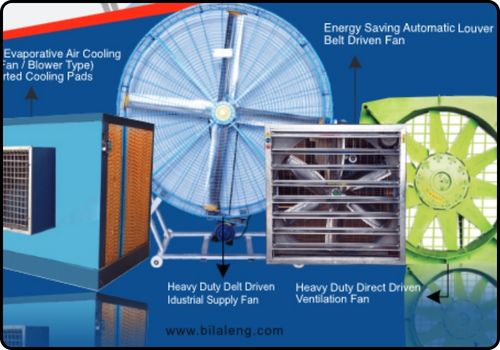
Axial fans move large volumes of air with relatively low pressure rise, making them the standard choice for general industrial ventilation in factories, warehouses, workshops, and storage facilities. In an axial fan system, fans are mounted in the walls or roof of a building and discharge hot air directly to the outside. Fresh air enters through purpose-designed inlet louvres or openings on the opposing face of the building, creating a cross-ventilation airflow pattern across the occupied zone.
Bilal Switchgear Engineering designs and manufactures axial fans in bracket-mounted and direct-drive configurations for Pakistani industrial applications. Key specifications that determine performance include blade diameter (ranging from 450 mm to 1800 mm for industrial applications), blade pitch angle (adjustable on premium units to optimise airflow against system resistance), motor rating (from 0.37 kW to 22 kW depending on size), and ingress protection rating (IP55 as standard for industrial environments to resist dust and moisture).
Selection note: A common sizing mistake is selecting fan quantity based on floor area alone without accounting for the heat load generated by machinery, lighting, and solar gain through the roof. A textile mill weaving shed with continuous loom operation generates significantly more internal heat per square metre than a general-purpose warehouse. Under-sized ventilation in process-intensive facilities creates persistent heat problems that additional fans cannot fully resolve after installation.
2. Evaporative Cooling Systems
Where axial fans alone cannot achieve acceptable working temperatures because outdoor air is itself too hot, evaporative cooling systems provide a practical and energy-efficient solution for Pakistan’s dry summer climate. Evaporative coolers use the latent heat of water evaporation to reduce supply air temperature. In central Pakistan, outdoor temperatures of 45 degrees Celsius can be reduced to 30 to 32 degrees Celsius at the cooler outlet using a well-designed evaporative unit, delivering a 13 to 15 degree temperature reduction to the working environment.
Evaporative cooling is effective in Pakistan’s climate because it works best in low humidity conditions. In Lahore, Faisalabad, and Multan during peak summer months, outdoor relative humidity is typically below 30 percent before the monsoon arrives, which is the ideal operating condition for evaporative technology. Coastal areas including Karachi experience higher humidity, which reduces evaporative cooling effectiveness, though properly sized systems still deliver meaningful temperature reductions even in more humid conditions.
Bilal Switchgear Engineering’s evaporative cooling units are designed for continuous operation in Pakistan’s industrial environments. See the full range on our Ventilation Division page.
3. Tunnel and Underground Ventilation Systems
Tunnels, underground parking structures, metro rail systems, and below-grade industrial spaces present ventilation challenges that differ fundamentally from surface facilities. Tunnel ventilation systems must manage vehicle exhaust pollutants, remove heat generated by traffic and mechanical equipment, and in fire emergencies, extract smoke and hot gases to maintain a tenable environment in the escape path long enough for occupants to evacuate.
The two primary approaches to road and rail tunnel ventilation are longitudinal systems, where jet fans installed within the tunnel create a longitudinal airflow from one portal to the other, and transverse systems, where supply and extract air are ducted through the tunnel length via separate distribution systems. For shorter tunnels, semi-transverse systems providing supply-only or extract-only ducting with portal exhaust or inlet are often the most economical solution.
Project reference: Bilal Switchgear Engineering designed and installed the tunnel ventilation system for the Swat Motorway tunnel project in collaboration with Frontier Works Organization (FWO Pakistan). The system involved axial fan stations, jet fan arrays, emergency smoke extraction capability, and SCADA-integrated environmental monitoring to maintain safe conditions for motorists continuously. This remains one of the most technically demanding ventilation installations completed by any Pakistani company.
4. Industrial Exhaust Blowers for Process Ventilation
Many industrial processes generate localized concentrations of heat, dust, fume, or chemical vapor that require source capture ventilation rather than general dilution ventilation. Welding operations, surface finishing processes, chemical mixing, and high-temperature manufacturing all fall into this category. For these applications, exhaust blowers with purpose-designed hoods capture contaminants at source and duct them outside before they disperse into the general working environment.
Bilal Switchgear Engineering manufactures exhaust blowers in centrifugal and axial configurations for process ventilation applications. Selection criteria include the volume flow rate required to capture contaminants at the specified capture velocity, the static pressure the blower must overcome in the ductwork system, the temperature of the extracted air (critical for high-temperature processes), and the nature of the contaminant (corrosive fumes require non-metallic or coated fan components).
How to Size an Industrial Ventilation System Correctly
Correct sizing of an industrial ventilation system is an engineering calculation, not a rule of thumb. Systems sized using simplified air changes per hour estimates frequently underperform because they do not account for the actual heat load in the facility. The proper sizing procedure involves three steps.
Step 1: Calculate the Total Heat Load
The total heat load comprises solar heat gain through roof and walls (calculated from roof construction and area, combined with local solar irradiance data), internal heat generated by process machinery and lighting, and metabolic heat from workers. Each of these components must be quantified separately and summed to give the total heat removal requirement in kilowatts.
Step 2: Determine the Required Airflow Volume
Using the total heat load and the temperature difference achievable between supply and exhaust air (based on the chosen ventilation strategy), the required airflow volume in cubic metres per second is calculated. For evaporative cooling systems, the target supply air temperature after evaporative cooling sets the temperature differential. For pure exhaust systems, the acceptable maximum internal temperature above ambient outdoor temperature sets the differential.
Step 3: Select Equipment for the Calculated Duty
Fan selection for the calculated duty point (airflow volume and static pressure) uses the fan manufacturer’s performance curves to identify the correct impeller diameter, blade configuration, and motor rating. Multiple fan units are almost always preferable to a single large unit because they provide partial redundancy and allow staged operation at reduced load conditions to save energy. Our engineering team provides duty point calculations and fan selections as part of the project design service at Bilal Switchgear Engineering’s Ventilation Division.
Ventilation for Specific Industries in Pakistan
Different industrial sectors in Pakistan have distinct ventilation requirements. Understanding the characteristics of each sector helps in specifying a system that addresses the actual operational conditions rather than a generic industrial standard.
Textile Mills and Garment Manufacturing
Textile weaving and spinning facilities generate significant process heat from loom motors and yarn tension systems, combined with cotton lint and dust that create both respiratory hazards and fire risks if allowed to accumulate. Ventilation systems for textile mills must provide general dilution ventilation for heat and humidity control, filtration of lint from exhaust air streams to comply with environmental regulations, and in some cases humidity control to maintain yarn tension within acceptable limits.
Food and Beverage Processing
Food processing facilities require ventilation systems that maintain hygienic conditions, prevent condensation that promotes microbial growth, and control cooking and process odours. HVAC and ventilation in food production areas must use materials and configurations that comply with food safety requirements, including smooth internal surfaces, accessible cleaning provisions, and HEPA filtration where cross-contamination between raw and finished product areas is a risk.
Cement and Heavy Industry
Cement plants, steel fabrication facilities, and other heavy industrial operations generate extreme heat loads, abrasive dust, and in some cases chemical fumes that place severe demands on ventilation equipment. Fan components in these environments must be selected for abrasion resistance, with heavy-gauge steel impellers or ceramic-coated components in dust-laden airstreams. Motor enclosures must be rated for dusty environments and frequent starts.
Warehousing and Cold Chain Logistics
Large-volume warehouses with metal roofing experience extreme solar heat gain in Pakistani summers. General mechanical ventilation using roof-mounted exhaust fans with natural inlet louvres is the standard solution. For cold chain logistics facilities, the ventilation strategy must prevent warm humid air from entering refrigerated zones while maintaining adequate ventilation in loading bay and sorting areas.
Poultry and Agriculture
Poultry houses and agricultural facilities in Pakistan require carefully designed ventilation to maintain temperature and humidity within the narrow bands required for optimum animal welfare and production performance. Tunnel ventilation systems, where high-velocity axial fans at one end of a long building pull air through the full length, are the standard approach for broiler houses. Evaporative cooling cells at the inlet end provide temperature reduction in summer months. See our complete ventilation product range at bilaleng.com/services/ventilation-system/.
Controls and Monitoring for Industrial Ventilation Systems
A well-designed ventilation system with poor controls delivers inconsistent results and wastes energy. Modern industrial ventilation controls range from simple thermostat-based fan switching to fully integrated SCADA and BMS systems that monitor temperature, humidity, CO2 concentration, and particulate levels across an entire facility and adjust fan speeds through variable speed drives to maintain setpoints continuously.
Variable speed drives (VSDs) are one of the most cost-effective investments in an industrial ventilation system. A fan running at 80 percent of full speed consumes only 51 percent of the energy of a fan running at full speed (following the cube law of fan energy consumption). For facilities with variable occupancy or process loads, VSDs can reduce annual ventilation energy consumption by 30 to 50 percent compared to fixed-speed operation.
Bilal Switchgear Engineering’s Automation Division integrates ventilation controls with building management systems and SCADA platforms as part of complete facility engineering projects. Our MEP Division coordinates electrical supply, switchgear, and controls for ventilation systems as part of turnkey project delivery.
Designing Your Industrial Ventilation System in Pakistan
Industrial ventilation in Pakistan requires engineering that goes beyond minimum code compliance. The combination of extreme summer temperatures, high solar gain, energy-intensive industrial processes, and increasingly rigorous buyer and regulatory requirements means that facilities with inadequate ventilation face productivity, health, and compliance problems that grow more serious over time.
Bilal Switchgear Engineering designs, manufactures, and installs industrial ventilation systems for factories, warehouses, tunnels, and infrastructure projects across Pakistan. With 47 years of experience and an in-house manufacturing capability for axial fans, evaporative coolers, exhaust blowers, and tunnel ventilation equipment, our team provides engineering solutions matched to Pakistan’s specific climate and industrial operating conditions.
Contact our ventilation engineering team in Lahore to discuss your facility’s ventilation requirements and receive a preliminary system design proposal.
Frequently Asked Questions
What is the difference between an axial fan and a centrifugal fan for industrial ventilation?
Axial fans move air parallel to the fan shaft axis and are most efficient at high airflow volumes with relatively low pressure resistance. They are the standard choice for general building ventilation, warehouse cooling, and tunnel ventilation. Centrifugal fans move air perpendicular to the shaft axis and generate higher pressure, making them better suited for ducted systems with significant ductwork resistance, process exhaust applications, and applications handling dust-laden or particulate-bearing air streams.
How effective is evaporative cooling in Pakistan’s summer climate?
Evaporative cooling is highly effective in Pakistan’s pre-monsoon summer climate when outdoor humidity is below 30 to 40 percent. In Lahore, Faisalabad, and Multan during May and June, well-designed systems regularly achieve 12 to 15 degree Celsius temperature reductions at the supply air outlet. During the monsoon months of July and August, when outdoor humidity rises above 60 percent, evaporative cooling effectiveness reduces significantly. For facilities requiring year-round cooling, a combined evaporative and mechanical refrigeration system may be appropriate.
How many air changes per hour does an industrial building in Pakistan need?
Air change rate is a simplified measure of ventilation that should be used only for preliminary estimates, not final design. Typical industrial buildings require between 20 and 60 air changes per hour depending on heat load and process type. High-heat processes such as foundries and glass manufacturing may require 80 or more. The correct approach is to calculate the actual heat load and design the ventilation system to maintain an acceptable internal temperature above ambient rather than targeting an air change rate. Our engineering team provides heat load calculations as part of the ventilation design service.
Can industrial ventilation fans be integrated with a building management system?
Yes. Modern industrial ventilation systems integrate readily with building management systems (BMS) through standard protocols including BACnet, Modbus, and PROFIBUS. Integration allows centralized monitoring of fan status, temperature and humidity across the facility, energy metering for each fan circuit, and automated speed control through variable speed drives responding to temperature or CO2 setpoints. Bilal Switchgear Engineering’s Automation Division provides BMS integration for ventilation systems as part of complete facility engineering projects.
What maintenance does an industrial ventilation system require?
A well-maintained industrial ventilation system should receive quarterly inspection of fan blades for dust build-up, bearing wear, and blade damage; six-monthly inspection and re-greasing of shaft bearings; annual motor insulation resistance testing; annual inspection of inlet and outlet louvres and bird mesh for blockage; and annual testing of control systems and thermostatic setpoints. Blade build-up from dust or lint is one of the most common causes of reduced airflow performance and can reduce fan output by 20 to 30 percent if not addressed through regular cleaning.