


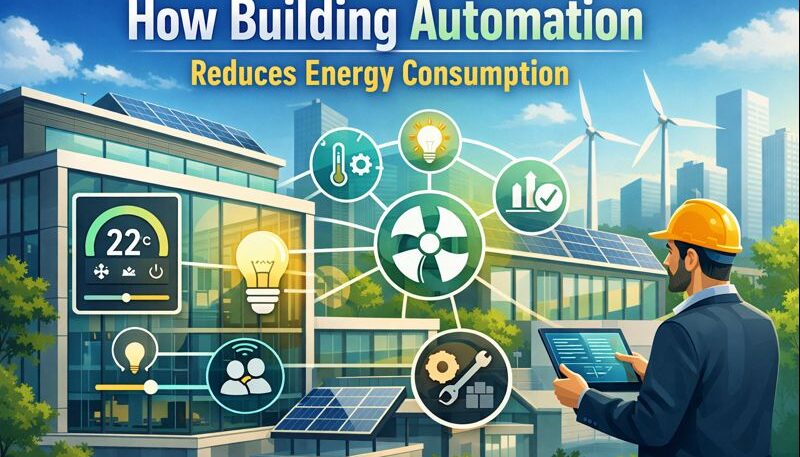
Energy rarely gets wasted in dramatic ways. It slips away quietly. The lights stay on longer than needed. Systems run because no one told them to stop. Over time, consumption rises, and no single moment explains why. We usually notice it when costs climb. Building automation changes this pattern by adding awareness. It allows buildings to respond instead of simply running.
Understanding Building Automation Systems
A building without automation behaves the same all day. It does not notice occupancy. It does not question demand. Automation introduces that missing layer. Sensors observe conditions. Controllers react. Systems begin to communicate. We often see buildings feel calmer once automation is active. Temperatures stabilize. Equipment cycles less aggressively. The building stops guessing and starts responding.
Why Energy Consumption Is High in Commercial Buildings
High consumption rarely comes from one mistake. It comes from habits built into systems. Manual settings remain unchanged for years. Equipment operates even when spaces sit empty. We see this repeatedly in offices and industrial facilities. The issue is not always inefficiency. It is a lack of feedback. Without insight, systems consume energy whether they serve anyone or not.
Key Ways Building Automation Reduces Energy Usage
Automation removes assumptions. Systems adjust based on real conditions. When occupancy drops, output follows. When demand increases, the response becomes measured. With building automation, energy use aligns more closely with activity. Waste reduces naturally, not through restriction, but through awareness.
HVAC Optimisation Through Automation
Heating and cooling respond best when they move gradually. Automation adjusts setpoints instead of forcing extremes. Chillers, boilers, and AHUs operate more smoothly. We notice fewer complaints when systems respond softly rather than aggressively.
Smart Lighting and Daylight Control
Lighting often consumes energy without purpose. Automation corrects this. Lights dim or switch off when daylight increases. Occupancy sensors prevent empty spaces from staying illuminated. The change feels subtle, yet the impact accumulates over time.

Occupancy Detection and Demand-Based Control
Buildings rarely operate at full capacity all day. Automation notices this. Systems reduce output when spaces are empty. This approach respects how buildings are actually used, not how schedules assume they are used.
Monitoring, Fault Detection, and Preventive Maintenance
Problems rarely announce themselves early. Energy drift often signals faults long before failure. Automation exposes these patterns. Alerts highlight irregular behaviour. Maintenance becomes proactive rather than reactive. We see teams act sooner because information arrives earlier. Systems stay stable for longer.
Optimising Building Automation for Maximum Energy Efficiency
Automation does not succeed on installation alone. Settings matter. Integration matters. Calibration matters. Building automation works best when systems reflect lived usage, not theoretical design. We often revisit settings after occupancy begins. Small adjustments make noticeable differences. Optimisation turns automation into a long-term tool rather than a static feature.
Future of Building Automation in Energy Management
Automation continues to evolve, but direction matters more than technology. IoT expands visibility. Analytics deepens understanding. We see value when systems support decisions instead of replacing them. The future lies in cooperation between people and systems, not control without context.
How Bilal Switchgear Engineering Delivers Energy-Efficient Automation Solutions
At Bilal Switchgear Engineering, we treat automation as a working relationship with a building. We design systems that adapt as usage changes. Our Automation services focus on clarity, integration, and control that remains understandable. Energy efficiency improves when systems support people, not confuse them.
FAQs
How does building automation actually reduce energy use?
It responds to real conditions. Systems stop running by default and start operating based on demand.
Can automation work in existing buildings?
Yes. Many systems integrate without full replacement. Upgrades often improve performance quickly.
Does automation remove manual control?
No. We design systems that support manual input while reducing unnecessary operations.
How does automation help maintenance teams?
Data reveals issues early. Maintenance becomes planned instead of reactive.
Is automation difficult to manage?
It depends on the design. Clear systems remain usable and effective over time.
Does automation support sustainability goals?
Yes. Reduced consumption directly lowers environmental impact without restricting comfort.